

Short-term breast cancer risk prediction
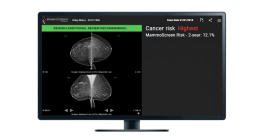
How is the risk of developing cancer determined by MammoScreen®?
To provide a risk prediction, MammoScreen analyses mammograms and assesses the individualised risk of developing breast cancer within the next 2 or 5 years.
What are the differences between traditional risk models and those calculated by image-based AI?
Comparison table with traditional risk models*
*Refers to AI in general.
FAQ
Yes, the model can identify cases at risk of preinvasive lesions with strong risk stratification capability, contributing to earlier detection.
Accurate, image-derived risk estimates enable individualized, tailored screening strategies, guiding targeted supplemental imaging for higher-risk patients.
No, the assessment relies solely on the analysis of the mammographic image, without requiring external data. This removes the need for staff to track down or enter personal and family histories—which can be complex to obtain, incomplete, or inaccurate—allowing for integration with no additional workload.