

Short-term breast cancer risk prediction
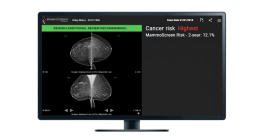
How is the risk of developing cancer determined by MammoScreen®?

To provide a risk prediction, MammoScreen analyses mammograms and assesses the individualised risk of developing breast cancer within the next 2 or 5 years.

What are the differences between traditional risk models and those calculated by image-based AI?

Comparison table with traditional risk models*

 
Feature Traditional Models (e.g. BCSC, Tyrer-Cuzick) Image-based, AI-calculated
Input data Clinical questionnaire: family and reproductive history, genetic factors, age, hormones, number of biopsies, sometimes including breast density.

Analysis of breast tissue texture on the mammogram to detect suspicious predictive patterns.

Time horizon 5–10 years or lifetime 1–10 years
Subjectivity Depends on the patient completing the questionnaire. Objective and automated: the AI detects patterns invisible to the naked eye.
Advantages
  • No specific imaging required to assess risk
  • Free or integrated into clinical tools
    Often underestimates risk in women without a family history
  • More accurate, especially in the short term (1–5 years)
  • Utilizes mammograms already performed
Limitations
  • Often underestimates risk in women without a family history
  • Relies on self-reported patient data
  • Administrative burden; time-consuming and resource-intensive to collect data
  • Relies on statistical averages
Requires a mammogram

*Refers to AI in general.

FAQ

Yes, the model can identify cases at risk of preinvasive lesions with strong risk stratification capability, contributing to earlier detection.

Accurate, image-derived risk estimates enable individualized, tailored screening strategies, guiding targeted supplemental imaging for higher-risk patients.

No, the assessment relies solely on the analysis of the mammographic image, without requiring external data. This removes the need for staff to track down or enter personal and family histories—which can be complex to obtain, incomplete, or inaccurate—allowing for integration with no additional workload.

Request a demo

Privacy Preference Center